
How the Course Is Prepared
On race day, while runners are out on the course giving it their all,many people have actually spent long hours preparing behind the scenes.
This year, under the slogan “Shine! Our Trail Community”, we will be sharing a series of articles introducing the behind-the-scenes work that supports the Echigo Country Trail.
Who prepares the course, and when?
Full-scale course preparation for the Echigo Country Trail usually begins around May each year.You might wonder, “Can’t you start preparing in April?”
Unfortunately, that’s not possible. This area is one of the heaviest snowfall regions in Japan.
Depending on the snow conditions each year, we can usually enter the mountains around Golden Week (early May).
Until then, most of the course remains buried under snow.
Every year, race preparation begins with patiently waiting for the snow to melt.
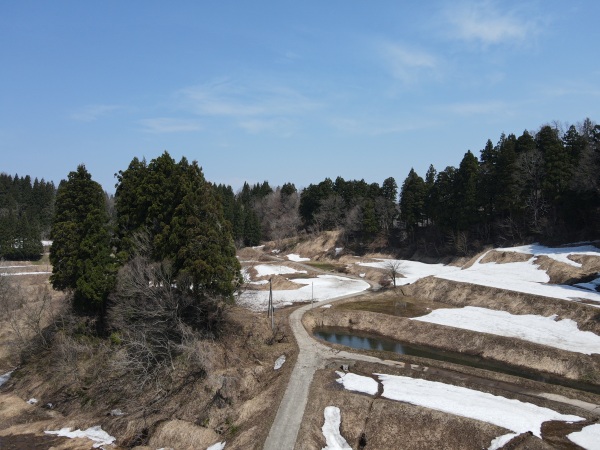
Late April onward
Once the snowmelt is confirmed, volunteer members of the race operations team are the first to move.They head into the mountains to inspect the course, carefully checking:
・whether the usual route can be used,
・if there are any collapsed or damaged sections,
・and whether temporary alternative routes might be needed.
To be honest, this inspection is always nerve-wracking. By the time it’s finished, there’s only about one month left until race day. At the same time, the mountains suddenly turn green, and grass begins to grow rapidly.
Mid-May
This is when grass cutting begins.
Grass grows extremely fast at this time of year, so the most critical window is one to two weeks before the race. There’s no way around it — this work depends entirely on manpower.
Men from the local villages along the course all come together to help. In total, 14 villages and organizations, 169 people, and 831 working hours are involved.
Once again, we want to express our deepest gratitude to everyone who helps make this possible.
In shaded forest trails, grass growth is relatively moderate, but in open areas with no shade, vegetation grows aggressively.Working under the hot sun in these sections is especially demanding.
In fact, just two weeks after the race, some parts of the route can already be hidden by grass again.


Alongside grass cutting, other tasks are carried out in parallel:
・installing and repairing steps on steep slopes,
・setting up safety ropes,
・and removing dangerous trees deep in the mountains, far from any villages.
Places inaccessible by vehicle and reachable only on foot are handled by younger members of the operations team.
Using nearby trees and terrain, they apply impressive, mountain-specific construction skills unique to trail work.
June
Another essential task is course marking. We try to place markings as frequently as possible so runners never feel lost. Still, every year a few runners take a wrong turn during the race — something we continue to reflect on and work to improve.


On the day before the race, race staff and volunteer crew members gather to paint course lines. This work is carried out mainly on paved roads within local villages, where the route can be surprisingly complex.When it rains the day before, drawing clear lines becomes extremely difficult, which can be very frustrating.
In this way, course preparation for the Echigo Country Trail begins only after the snow melts and then moves forward all at once, with the combined efforts of staff and volunteers.
In years when snowmelt is late, the waiting can be frustrating. Checking the mountains doesn’t make the snow disappear any faster — yet we still go to look, only to be laughed at by local elders who know better.
Within this short preparation period, the hands and dedication of many people come together to make the Echigo Country Trail possible.

